Medium Live Sito Ovest 14
Orange alert for flood risk
Why: the site is in the alert zone. Priority 3 of 5.
- Past
- Now (active)
- Soon (active)
Source: civil-protection criticality bulletin (CC BY 4.0), acquired on 23/10/2026.
RAISE is a platform for managing the risk of strategic infrastructure, site by site. It follows the ISO 31000:2018 process: an asset register, documents read and confirmed by an operator, a risk index with its explanation, approval by a second operator and the treatment plan. It assesses risk with techniques described in IEC 31010:2019. Live alerts name the exposed sites, with their priority and time horizon.
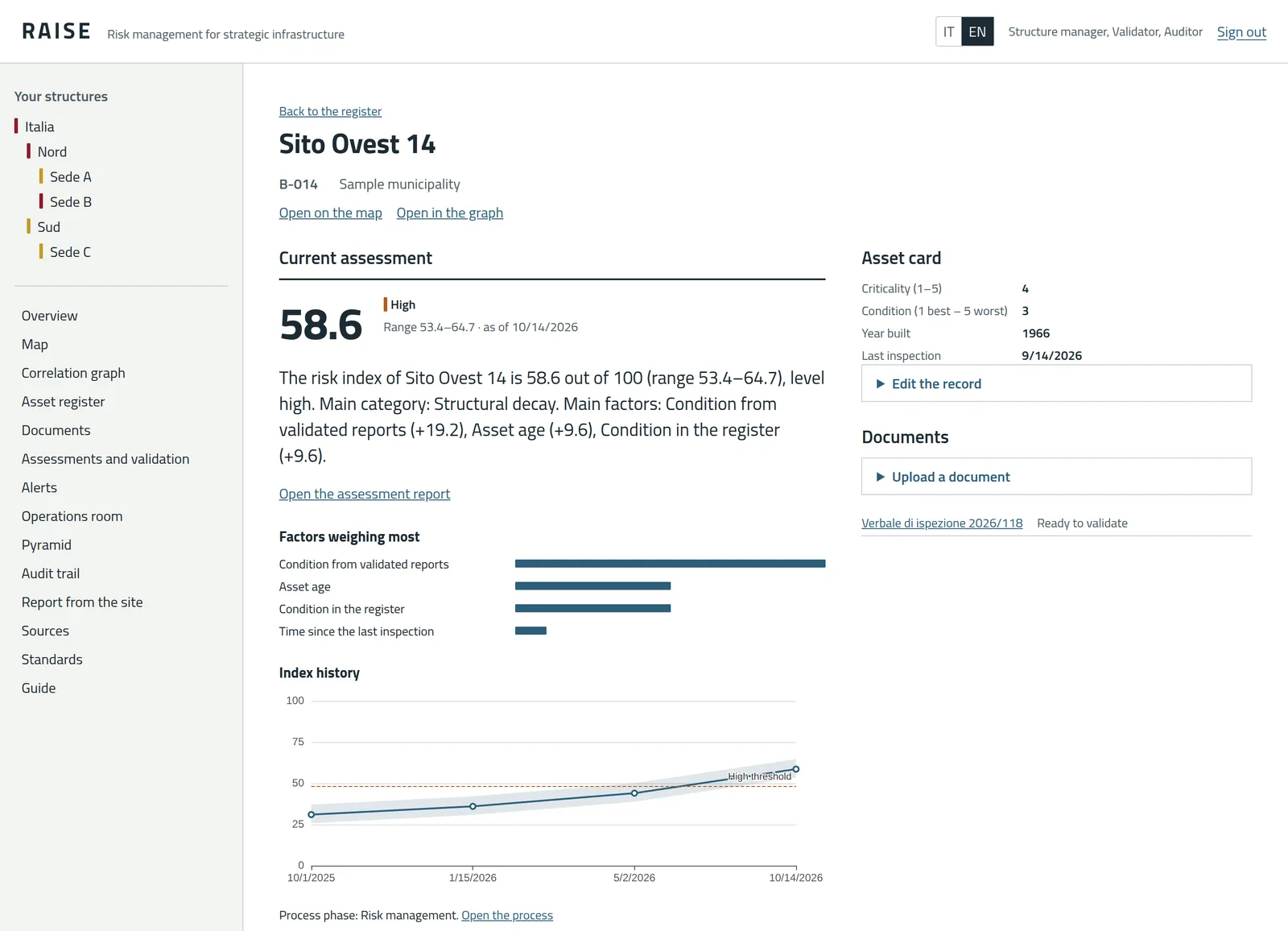
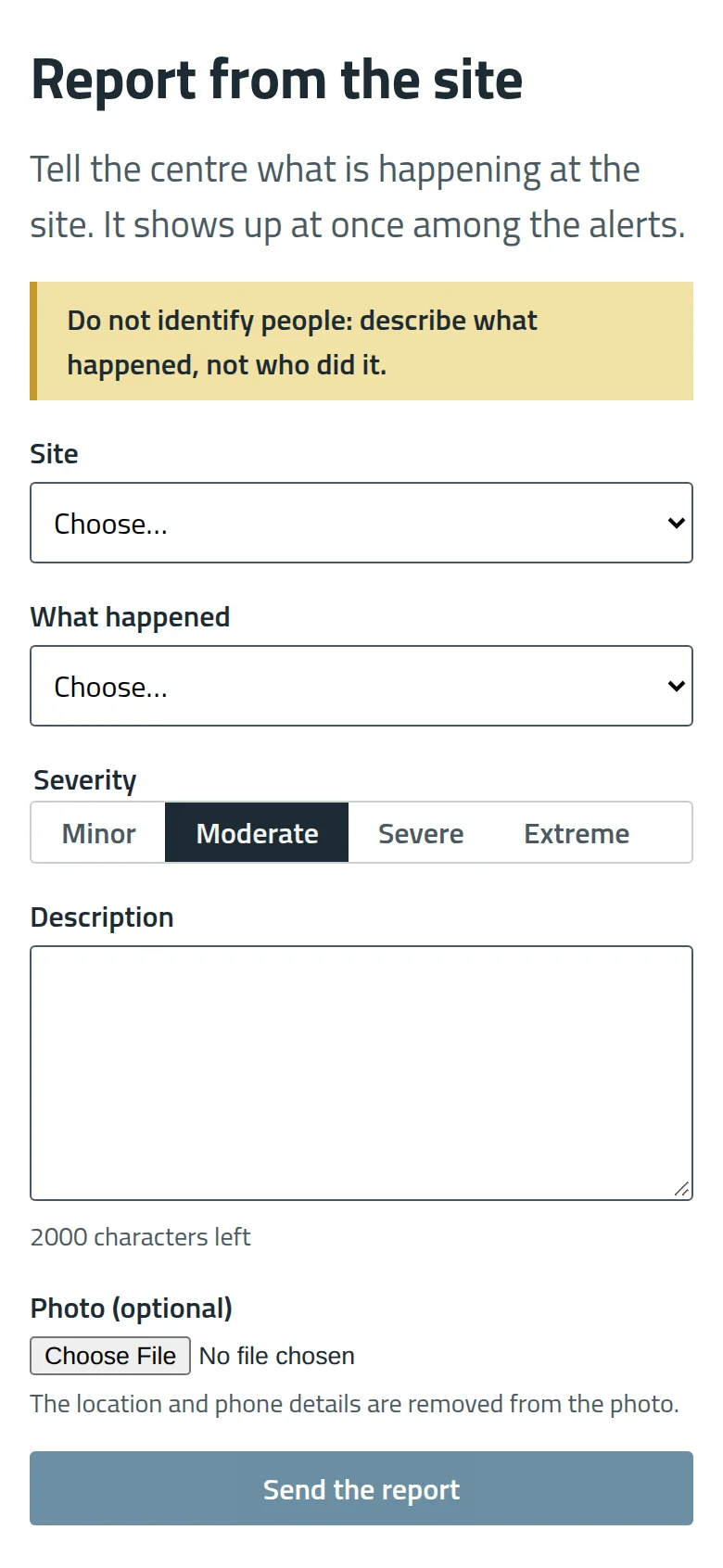
An asset record: the risk index with its range, the explanation, the most significant factors and the history. On the smartphone, a report from the site.
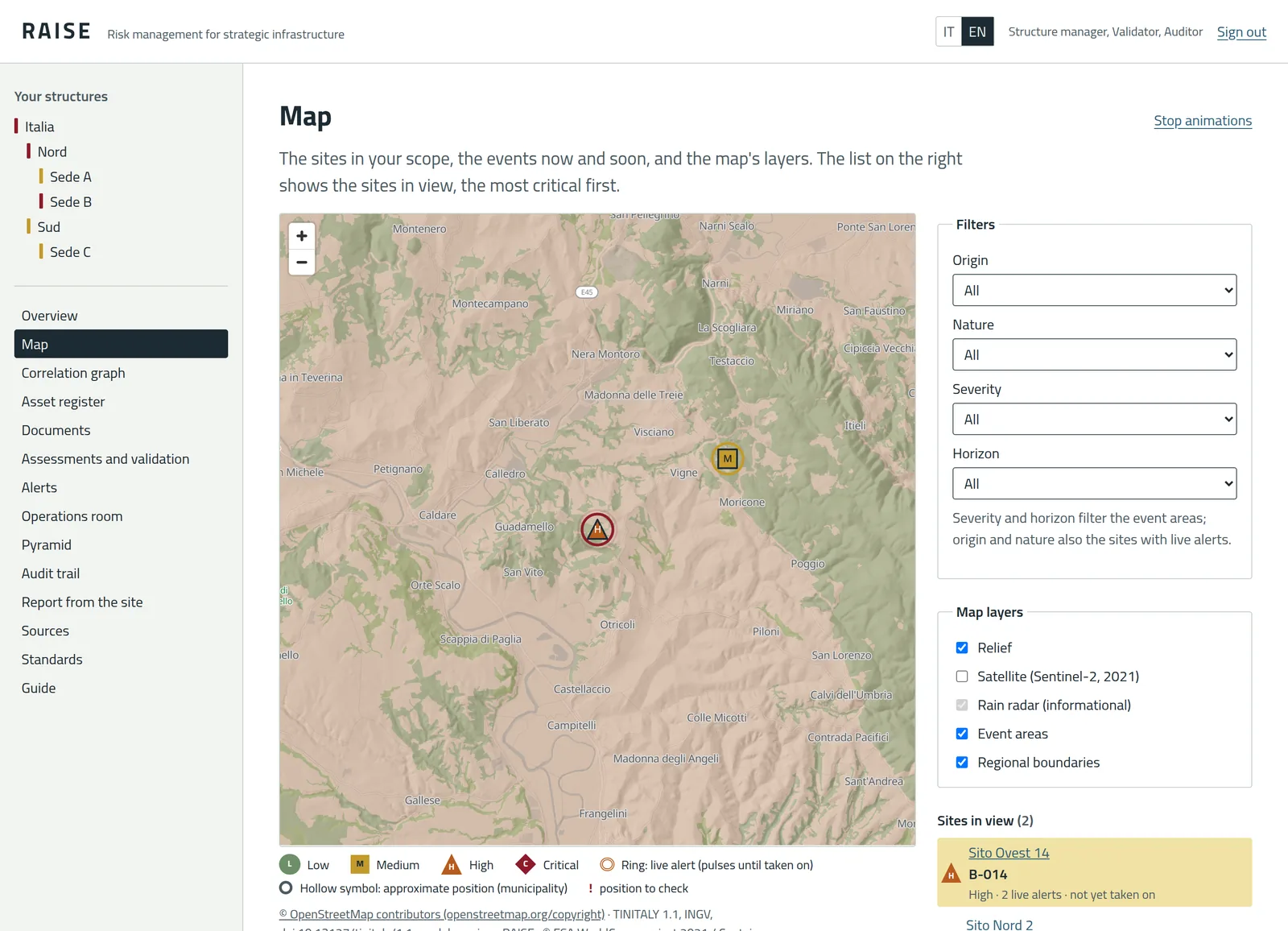
The map shows the sites in the user's scope, each with the shape and letter of its risk level; a ring marks an active alert and flashes until an operator acknowledges it.
Map data © OpenStreetMap contributors (ODbL); relief from TINITALY 1.1 (Tarquini et al., INGV, doi:10.13127/tinitaly/1.1) and Istat boundaries, processed (CC BY 4.0).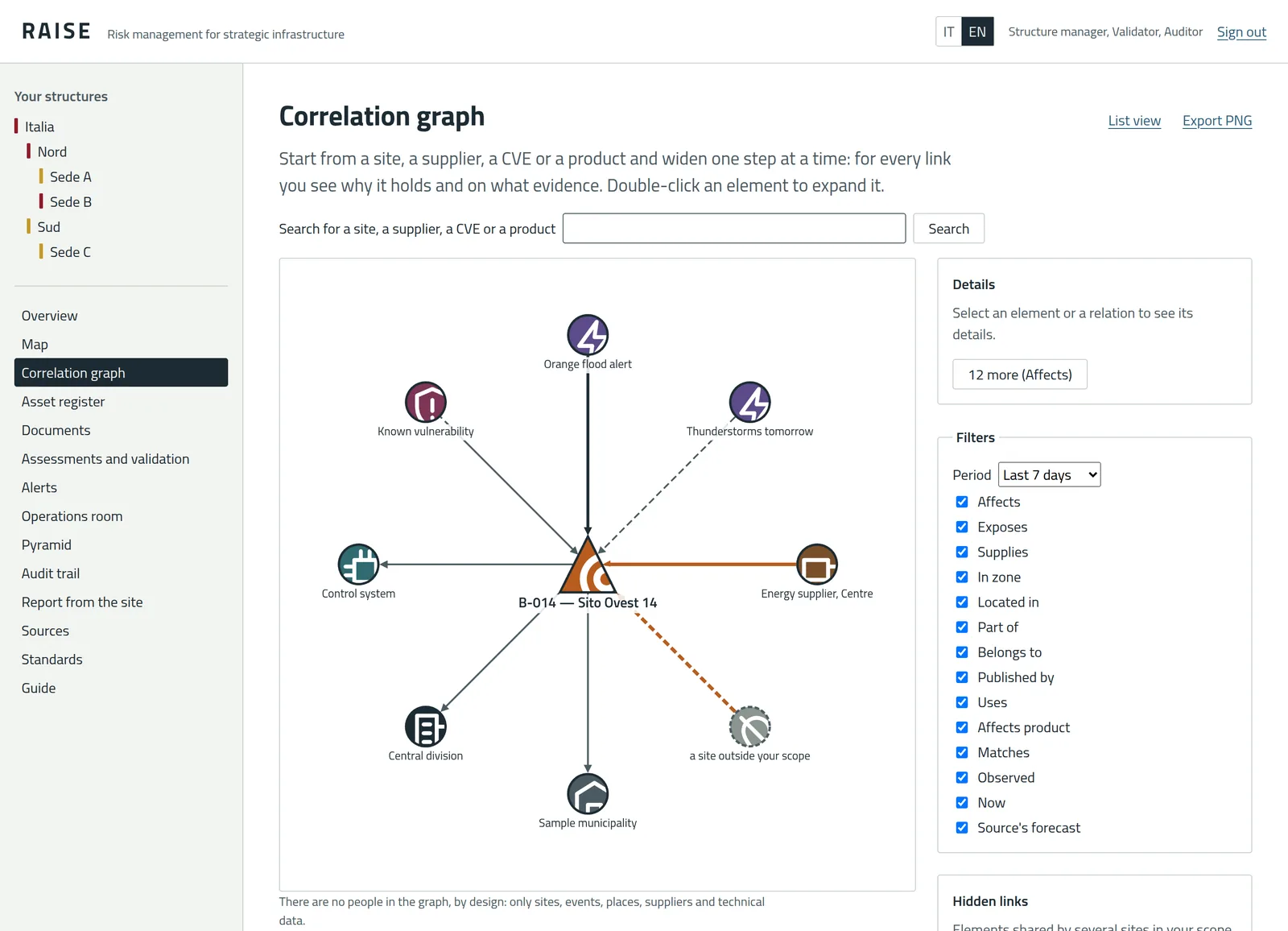
The correlation graph starts from a site and extends one level at a time: for each link it shows the reason and the supporting evidence. Sites outside the user's scope appear without their names.
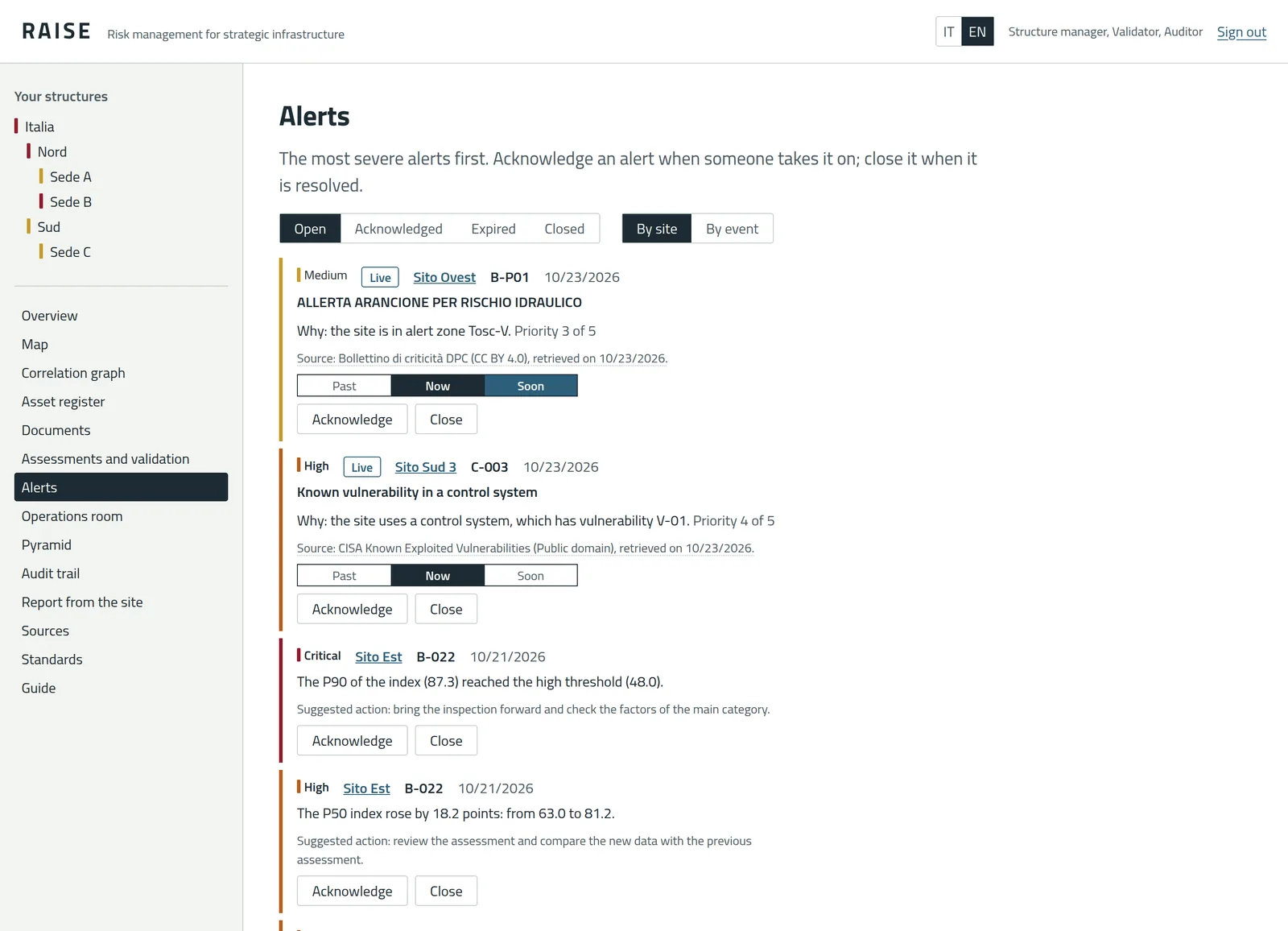
Alerts, ranked by severity, each with its time horizon: past, now, soon. The operator handling an alert acknowledges it and closes it once it is resolved.
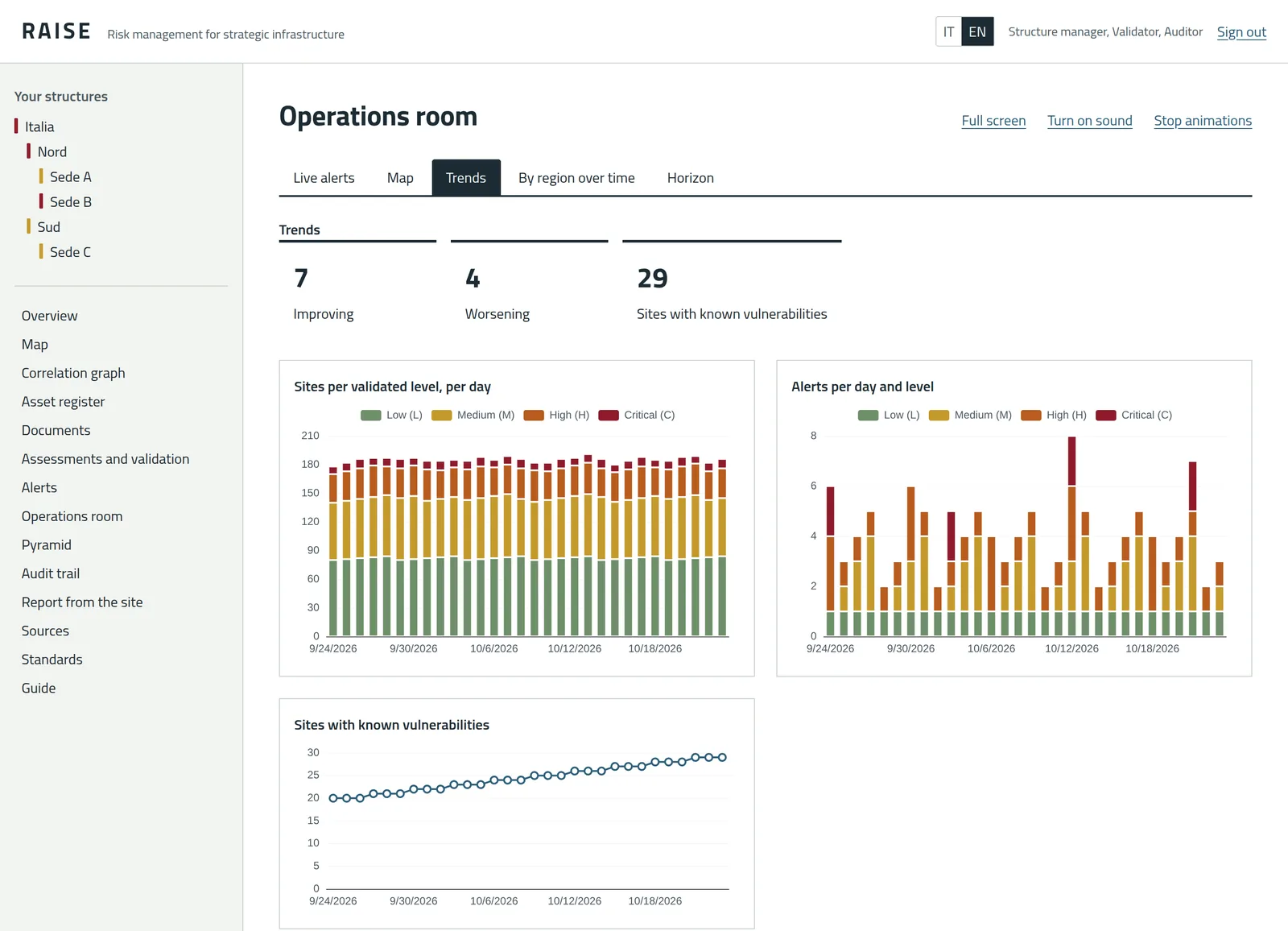
The operations room brings together live alerts, the map, trends, the trend by region and the horizon; this screen shows the daily trends.
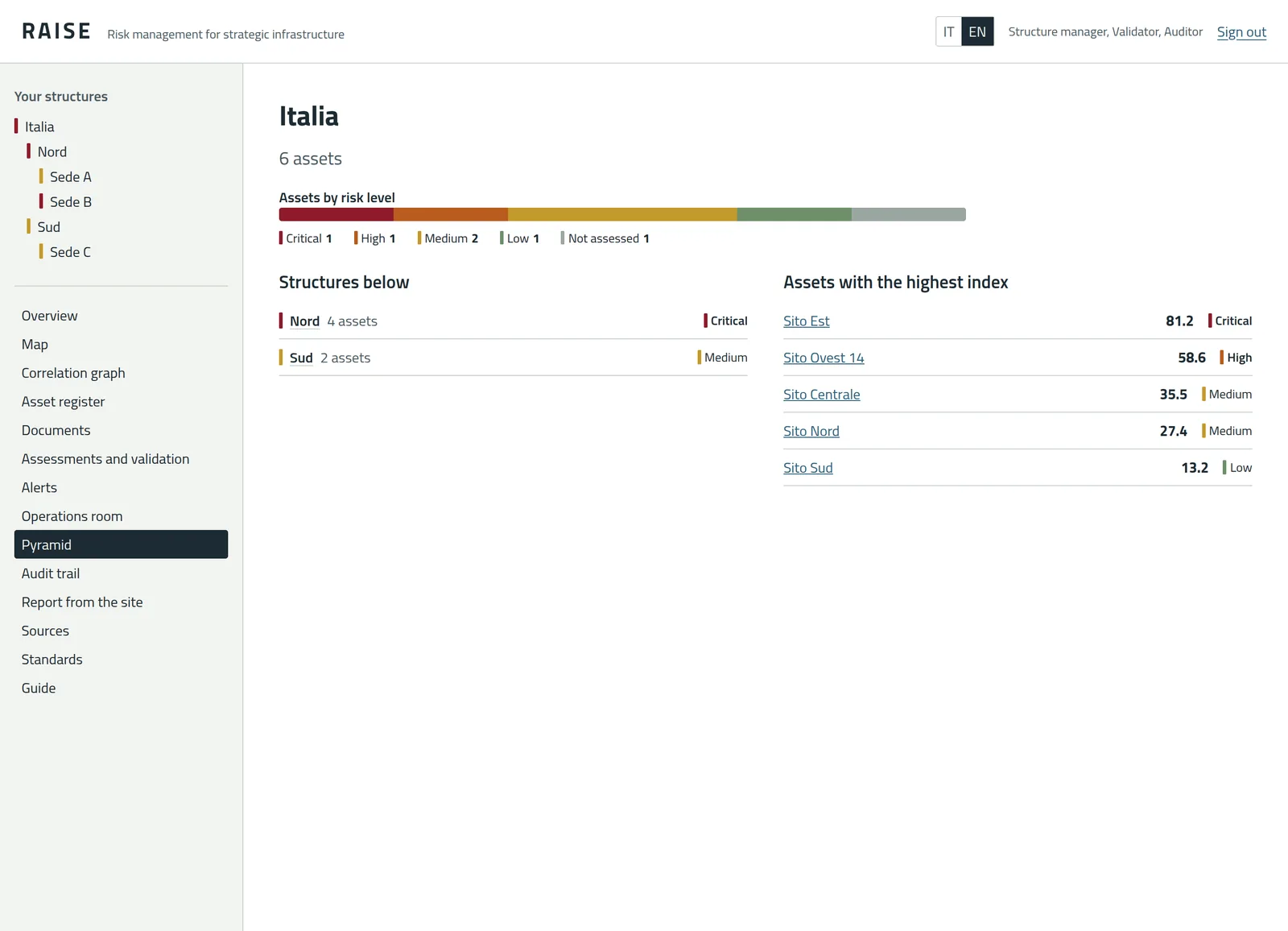
The pyramid: for each structure, its assets by risk level, the structures below it and the assets with the highest index.
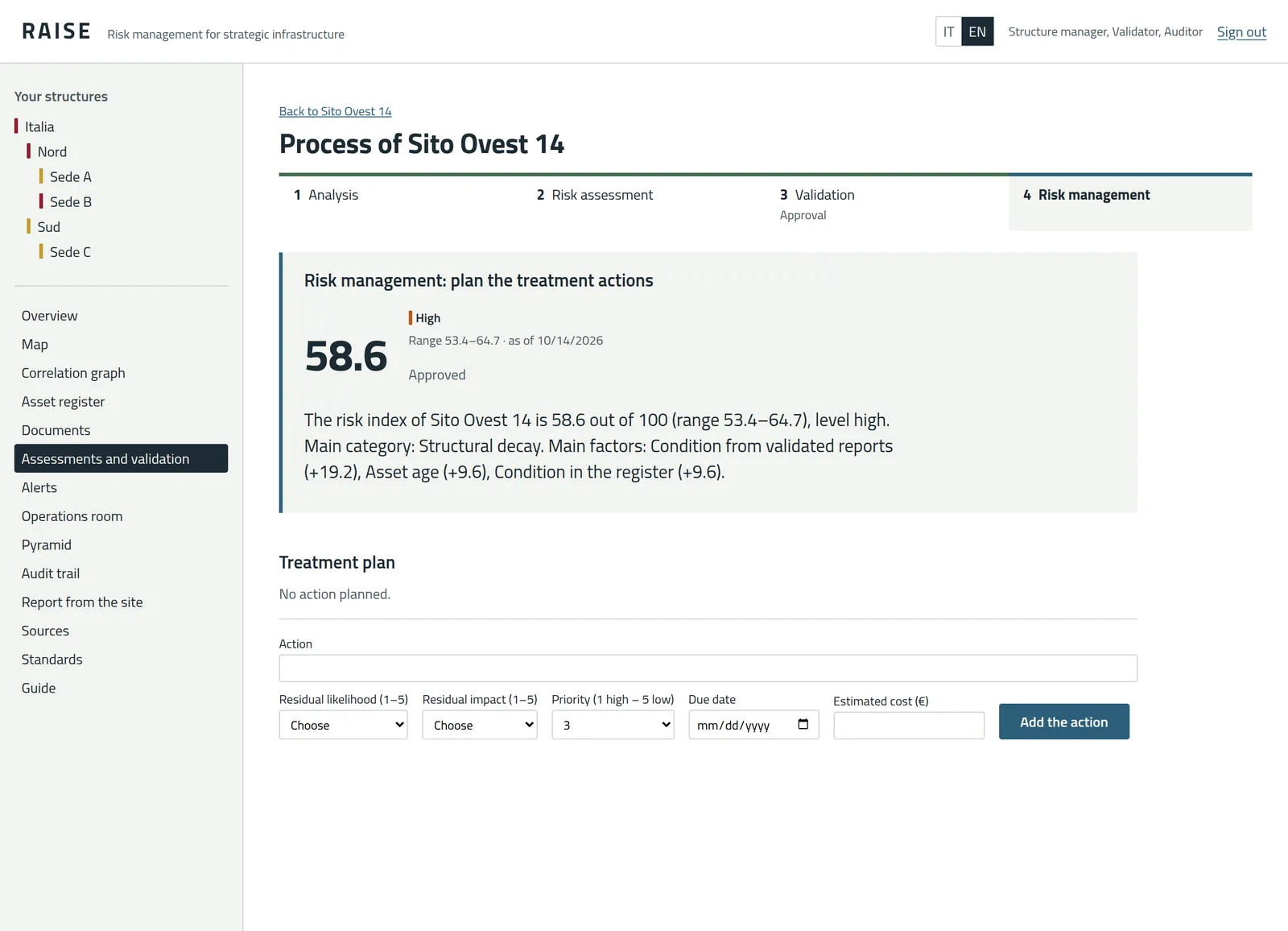
A site's ISO 31000 process, phase by phase: analysis, assessment, validation and risk management with the treatment plan.
The four levels and their colours are the same in the register, the pyramid and the alerts.
Every phase of the ISO 31000 process, from context to recording, has a corresponding function in RAISE.
The asset register with structure, type, criticality and condition; documents read by RAISE and confirmed field by field.
An index from 0 to 100 with its range, its level on the scale and the most significant factors, explained in plain language.
The action plan with owner, due date and cost, and the residual risk that follows.
Alerts when the index trends upwards and live alerts from official sources, site by site, each with its time horizon.
Every action in a chained audit trail that can be verified at any time; printable reports and register export.
The process moves from Analysis to Risk assessment, then to Validation, and only then to Risk management. Whoever submits an assessment cannot approve it: the decision rests with a validator, who must be a different operator. Every approval or rejection is recorded with its reason in the audit trail; a rejection returns the asset to the assessment phase.
Complete record and validated documents
The assessment is computed
Approved by a second operator
Treatment plan
RAISE reads public bulletins and warnings (civil-protection alerts, weather warnings in CAP format, cyber-security advisories, the catalogue of exploited vulnerabilities) and links them to the sites concerned. Each alert states the event, why it concerns the site, its priority from 1 to 5, the source with its licence and the date the data was acquired.
Medium Live Sito Ovest 14
Orange alert for flood risk
Why: the site is in the alert zone. Priority 3 of 5.
Source: civil-protection criticality bulletin (CC BY 4.0), acquired on 23/10/2026.
Live events never change the validated index: they are taken into account in the next assessment, which only an operator can approve.
Operators on site can also send a report from a smartphone: the centre receives it immediately, linked to the site.
Structures form a pyramid: the top, intermediate levels and local sites. Each user sees their own structure and the ones below it; assets outside their scope are not shown to them. There are six roles: operator, structure manager, executive, validator, auditor and administrator.
The index runs from 0 to 100 and comes from a transparent formula applied to factors from the asset, the territory and the threats. A Monte Carlo simulation provides the range between the 10th and the 90th percentile around the central value. The explanation reports the main factors with their exact contribution; a missing value stays neutral and is flagged.
No. Artificial intelligence reads the documents and proposes the fields, which an operator confirms. The index comes from a transparent formula, and every assessment goes through a validator, who cannot be the operator who submitted it.
From official public sources: civil-protection alerts, weather warnings, cyber-security advisories and the catalogue of exploited vulnerabilities. Each alert states the source, the licence and the date RAISE acquired the data.
No. Live events are evidence to consider in the next assessment. The validated index changes only with a new assessment approved by an operator.
It remains a proposal until an operator confirms, corrects or rejects it, field by field, with the source page alongside. An unconfirmed field never enters the assessment.
Italian and English: each user chooses their own. The user manual is also available in both languages.
It means the work goes through the same phases as the standard: context, assessment, treatment, monitoring and recording. In RAISE each phase has its function, from the asset register to the audit trail.
Only the users who have that site in their scope, that is in their own structure or in one below it. For all other users the site is not visible.
Write to commerciale@fidemsrl.it or call +39 045 983044: we will walk you through the whole process in RAISE, from reading the documents to the treatment plan.
A demo of the whole process, from reading the documents to the treatment plan, with live alerts and the audit trail.