How RAISE works: a night of rain in Ancona
Organisations responsible for strategic infrastructure have to answer three questions: what has happened to their sites, what is happening now and what may happen tomorrow. RAISE answers all three in one place, and every answer rests on evidence that can be checked. This is the story of an organisation, an orange bulletin and a night of rain in the Marche.
The afternoon bulletin
In the afternoon the Protezione Civile, Italy's civil protection department, publishes its criticality bulletin: for the following day, in one of the Marche alert zones, the colour is orange for hydraulic and hydrogeological risk.
Shortly afterwards the bulletin reaches RAISE, which runs in-house and is connected to the official sources the organisation has chosen.
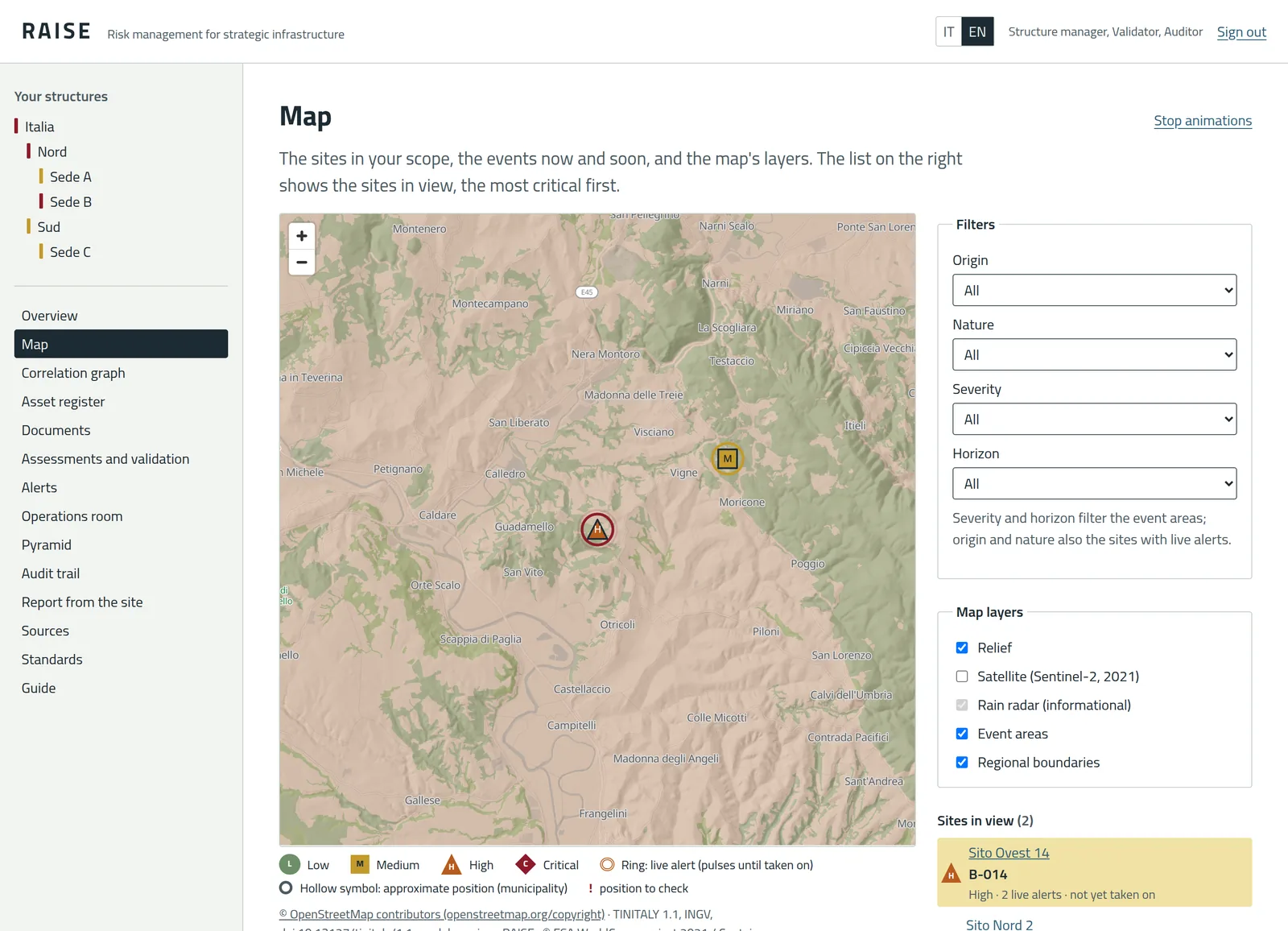
In Rome, in the head office's operations room, a wall screen updates as soon as the bulletin arrives. On the map a ring appears around each site in the zone, and a second ring flashes until an operator acknowledges the alert. The affected area has a dashed outline, because the event has not started yet. On the screen beside it, the regional chart shows alerts rising in the Marche.
Each alert states what is happening, why it concerns that particular site, how urgent it is and which source it comes from. The original warning is kept, and operators and auditors can consult it.
Ancona and Rome
In Ancona, at the regional structure, Chiara is the operator on shift. Her screen shows the alerts for the Marche sites she is responsible for: those of her structure and of the structures that report to it.
Elena, on the executive team, sees every site in Italy; on the national map, the sites with the most serious alerts always stand out.
Chiara switches to the event view: each bulletin takes one line, with the affected sites grouped beneath it, so even a warning that affects many sites stays easy to read. Chiara presses “Acknowledge”, and in Rome the second ring stops flashing.
A shared supplier
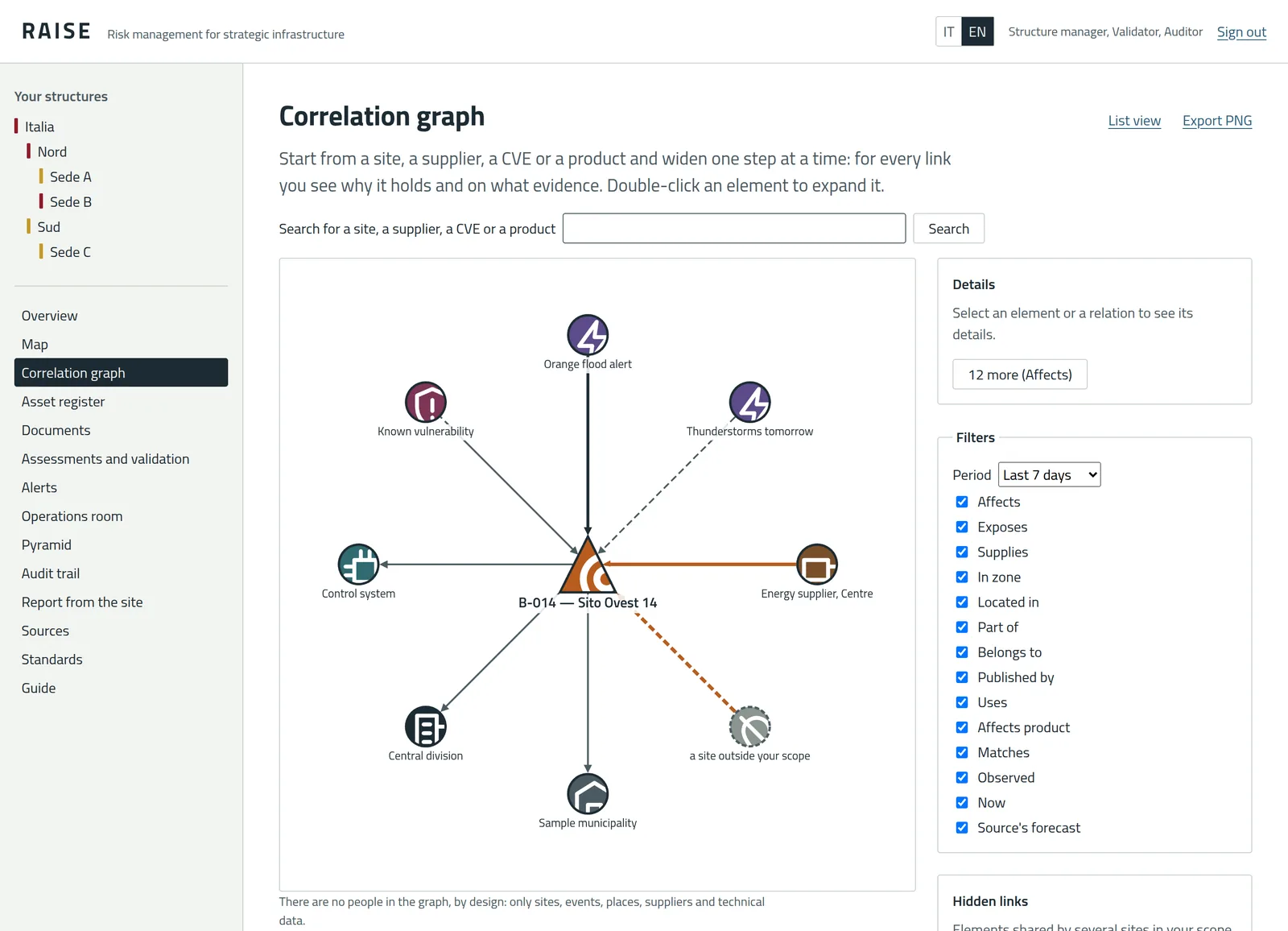
Chiara opens the page of a site south of Ancona. In the “Exposed dependencies” section there is a new line: the site's electricity supplier has a plant right inside the orange zone. RAISE flags this indirect exposure on the site's page, on the map and in the correlation graph.
In the graph, Chiara opens the supplier and sees what is connected to it: the same supplier also serves a site in Macerata, and for each link the graph shows the reason and the evidence. The Macerata site in turn depends for its telecommunications on a site of another structure; Chiara sees that site's service, how critical it is and whether it is exposed.
Two kinds of forecast
In Rome, the forecasts screen shows two kinds of forecast, always kept apart: those published by official bodies, marked “Source's forecast”, and those produced by RAISE.
That evening RAISE puts forward a forecast drawn from the news: a public demonstration has been announced for the following Saturday in Bari, not far from a site. The forecast states in plain words how likely the event is, with the evidence and the reasoning behind it. An operator in the room reviews and confirms it, and the forecast becomes a forecast alert, easy to tell apart from the others.
The report from the site
Before dawn the next day the rain arrives, and on the map the area's outline turns solid: the event has started.
Davide, a field operator at the site south of Ancona, sees water coming into an equipment room. On his phone he opens “Report from the site”: he picks the site, “flooding” and the severity, types a few lines and takes a photo.
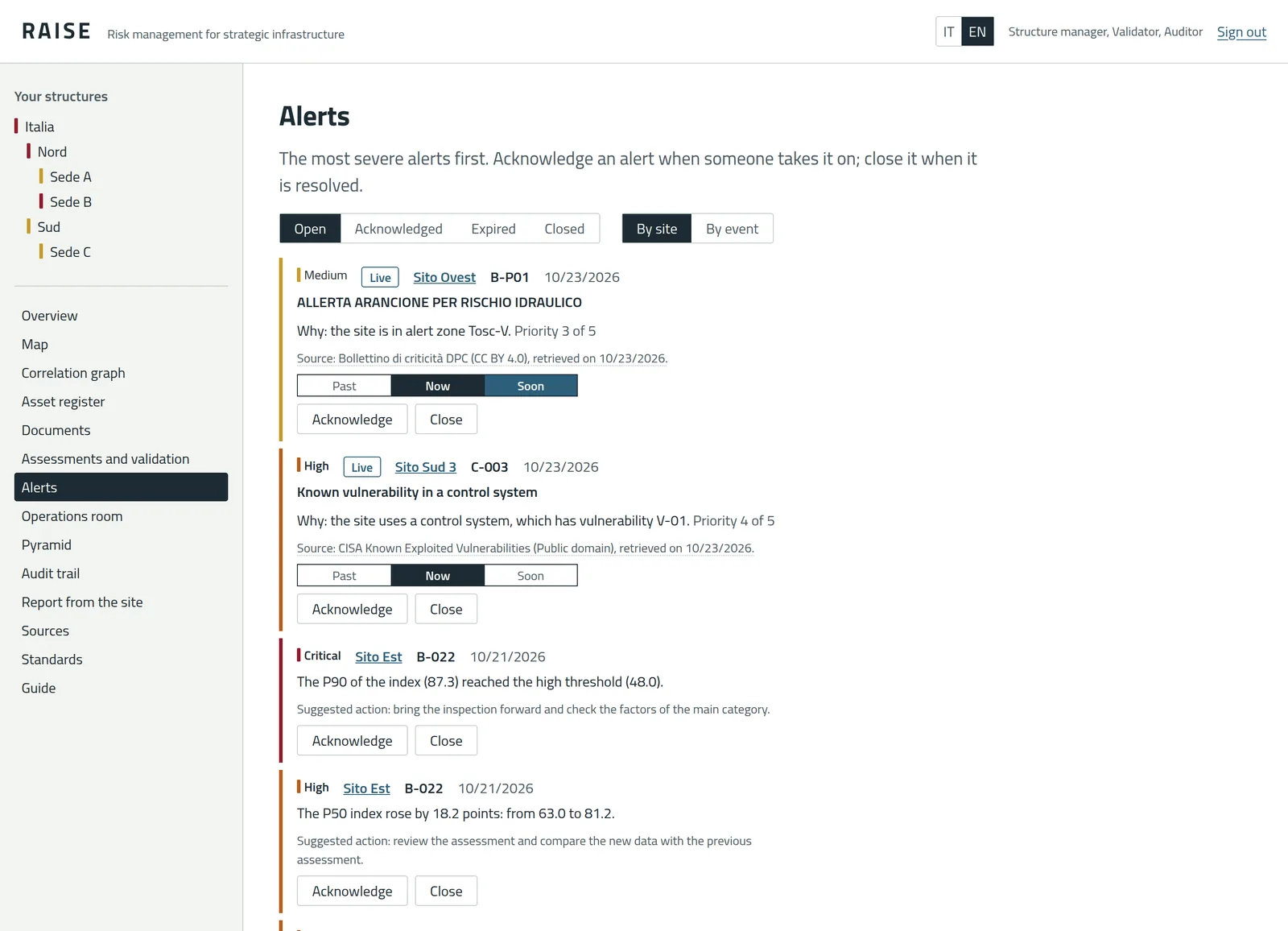
In the Ancona operations room the report arrives at once as an alert and becomes a ticket for the site, with a status, the assigned operator and a deadline for taking charge. The night operator is busy on the phone with another site: when the deadline expires, RAISE escalates the ticket to the level above, where the operator on shift in Rome takes charge.
Soon after, an update to the bulletin arrives: the zone turns red. RAISE updates the existing alert and, because its severity has risen, reopens it. The second ring starts flashing again, and the screen in Rome plays the sound used for critical alerts.
The call from the ticket
When Chiara is back on shift, she opens the ticket and finds all of the night's updates: the comments, the photo, the note from the operator in Rome, with every step recorded in RAISE.
Chiara presses the call button: a private video room opens from the ticket, hosted in RAISE, and Davide joins from his phone with his usual sign-in. He shows her the water level and the electrical panel, still dry. The decisions taken during the call are noted on the ticket.
Assessing the risk
Once the rain has passed, Davide uploads the inspection report: RAISE reads the document and proposes the details, which Chiara checks and confirms.
In RAISE an alert and an assessment are separate: the alert follows the event, while the assessment is updated when the structure manager revises it and a validator approves it. The night's events feed into the assessment as evidence.
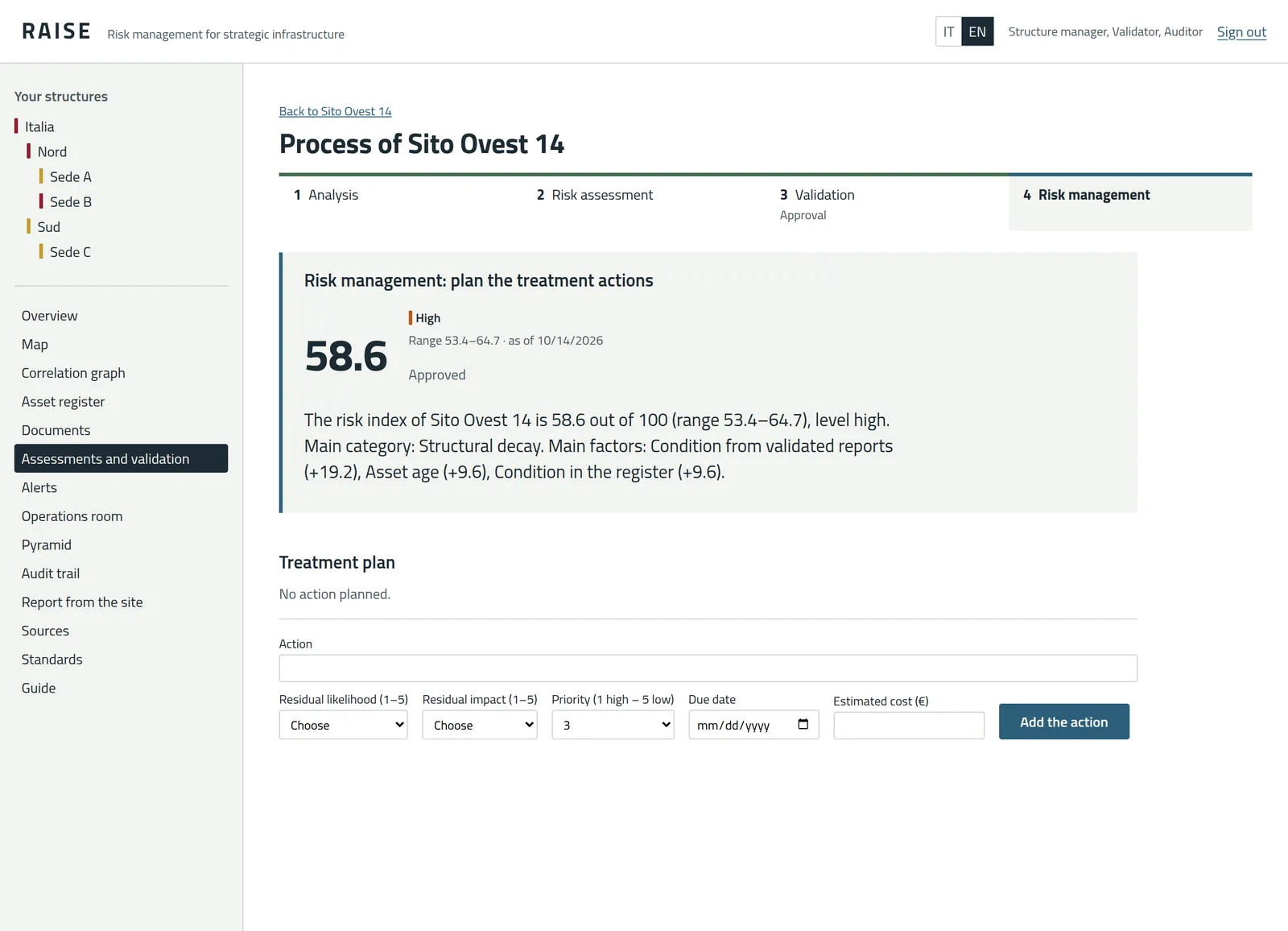
Luca, who manages the regional structure, prepares the new assessment. RAISE gives the most likely value and the range within which it can vary, and explains which factors are the most significant. Luca sends it for validation.
Sara, a validator in Rome, reviews it: approval always rests with a validator other than the assessment's author. Sara approves it and writes down her reasons, which stay on record. Then comes the treatment plan: each action has an owner, a deadline, a cost and the residual risk expected after the work. Each risk also has an owner, named from the moment it was identified.
Even after the planned actions, the residual risk exceeds the tolerance threshold that the executive team set for the Marche structure, and the decision passes to the level above. Elena formally accepts the risk for as long as the works take; the decision is recorded with its author, date, reasons and evidence. The assessment report, ready to print, states the method followed, built on ISO 31000:2018.
The record and the review
Every step of this story is in the audit trail: the bulletin received, the alert opened, updated and closed, the site report, the ticket passed to Rome, the validation with its reasons, the acceptance of the risk. The trail makes any change evident: Giorgio, the auditor, checks its integrity with a button, and RAISE runs the same check every night.
When the warning ends, the alerts move to the “Expired” list, where an operator closes them by stating the outcome. Chiara closes the one for Davide's site with “There was damage or disruption”, the others with “No impact”. After the works, the actual residual risk is compared with the expected one.
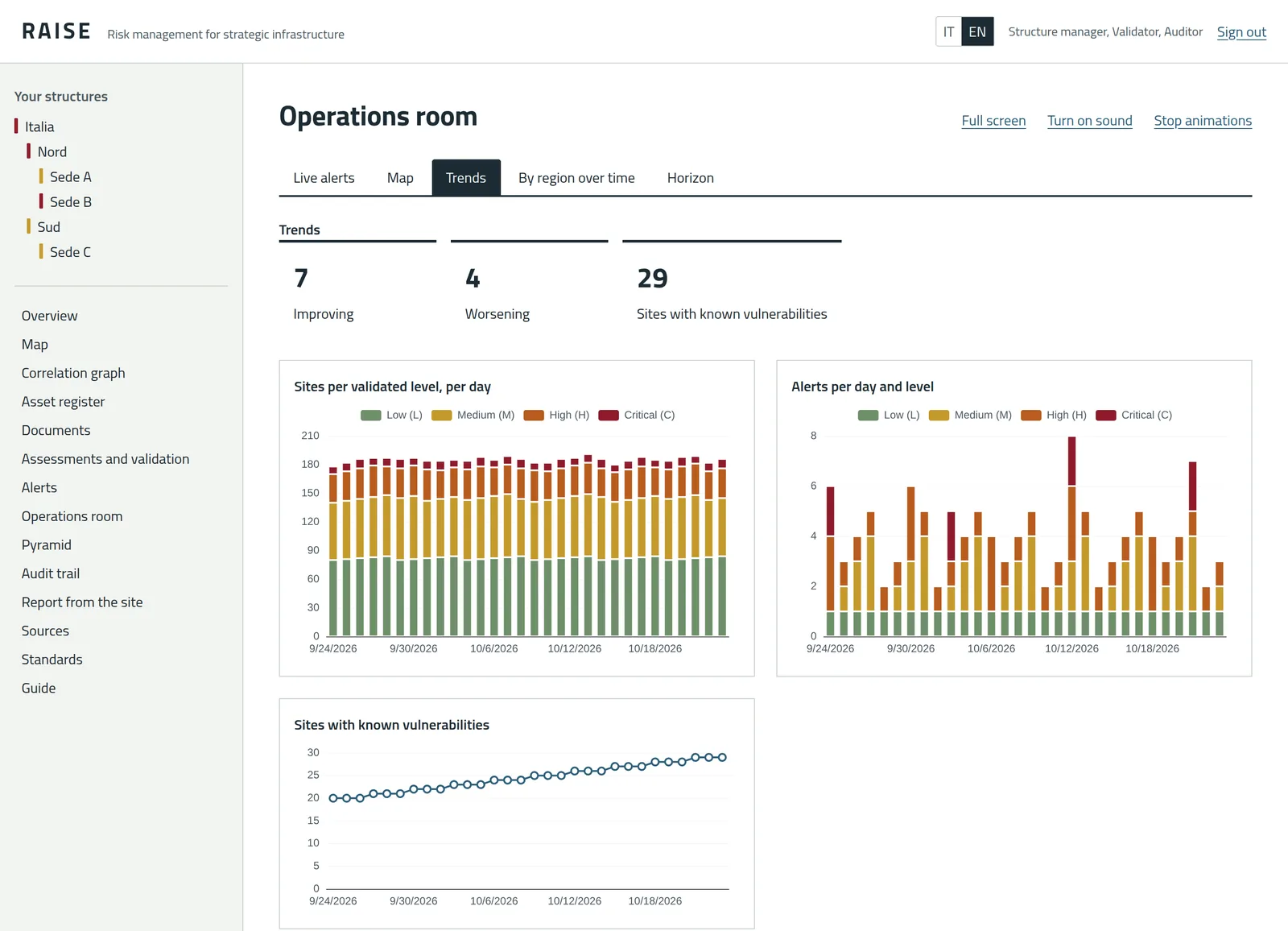
These outcomes are used to improve the forecasts. RAISE can replay past bulletins and show which alerts it would have raised; with the outcomes in hand, the executive team sees, for each risk category, how far ahead the warnings arrive and how many turn out to be false alarms. The trends screen shows which Marche sites are improving and which are getting worse.
More than a tool
RAISE is built on ISO 31000:2018 (context, assessment, treatment, monitoring and review, recording and reporting, with communication and consultation throughout), and to assess risk it uses techniques described in IEC 31010:2019. Its design is also guided by other recognised standards for secure development, information security and the responsible use of artificial intelligence.
Beyond any single feature, it is the way of working told in this story that makes RAISE more than a tool.